Start with specimen and signals
Describe the specimen and its container before listing instrument features. State whether you plan to observe a prepared slide, a culture vessel or another sample format. Give the relevant dimensions and access restrictions, and identify any handling conditions your laboratory requires the proposed arrangement to accommodate.
Next, list the signals you want to collect. If fluorescence labels are involved, provide their identities and the combinations you intend to observe. Ask the supplier to explain the proposed configuration against that list, rather than choosing a system from a channel count alone.
Imagine a project that needs images from several positions over time. Your request should explain the planned sequence and the records you need afterward. It should also identify who will approve the acquisition result. Leave the choice of acceptance criteria with the technical team responsible for the experiment; a quotation cannot establish that the biological question has been answered.
Separate the work you need to perform now from possible future work. Ask the supplier to identify any proposed additions for the latter as separate options. Do not let an unconfirmed future requirement disappear into the description of the standard configuration or into a general statement about expandability.
List excitation and detection separately
Create separate rows for the light sources and the detection arrangement. Ask for the supplied laser wavelengths, detector types, detection bands and the way channels are selected or combined. Request an explanation of any configuration-dependent restrictions relevant to your signal list.
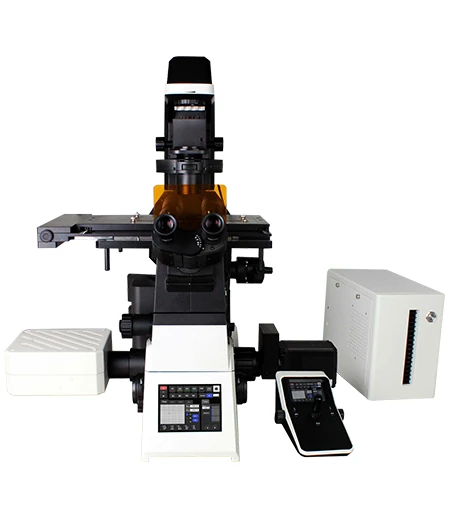
The published A64.1010 information lists four laser sources and four PMT detectors. Those counts are useful inquiry fields. They do not, by themselves, identify the supplied wavelengths, detection settings or compatibility with your labels. Ask for those details in the current offer.
| Configuration field | Information to request |
|---|---|
| Specimen | Format, dimensions and handling requirements |
| Excitation | Supplied sources and wavelength list |
| Detection | Detector arrangement and proposed collection bands |
| Acquisition | Positions, depth, channels and timing to discuss |
| Deliverable | Required images, metadata and export workflow |
Keep the table tied to one proposed model and configuration. Do not fill a missing field from a neighboring model's description.
If you want alternatives, request a complete table for each. Ask the supplier to identify what changes between proposals and which requirements remain unresolved. Your technical team can then review the differences against the same specimen and acquisition brief, without having to reconstruct the scope from scattered messages or screenshots.
Choose objectives around access requirements
Ask for the objective list as individual items, with the information your laboratory needs to assess each option. Request magnification, numerical aperture, working distance, immersion requirements and the intended specimen arrangement. Have the supplier identify any constraints involving the vessel, cover glass or stage insert you plan to use.
Keep the sample mounting discussion practical. If your laboratory already uses a particular holder or vessel, provide its identification and dimensions. Ask whether it is included, needs an adapter or requires a different arrangement. A model photograph is not a fit check.
For motorized components, ask which movements and changes are available through the quoted controls. Record what the operator still does manually. The A64.1010 description names several motorized microscope components; confirm the actual supplied combination instead of treating the word “motorized” as a complete account of the workflow.
Describe acquisition tasks instead of feature labels
Write the sequence you want to run. Identify the positions to revisit, the depth information to collect, the channels to record and the timing requirements to discuss. Ask which parts can be combined in one acquisition and which need separate operations in the proposed software.
As technical background, confocal imaging uses optical sectioning, and confocal descriptions distinguish image collection across depth, time and fluorescence signals. The Leica Microsystems overview explains these concepts. Its optional technologies and performance descriptions do not establish capabilities of an OPTOEDU configuration.
The A64.1010 and A64.1020 model pages describe acquisition functions such as multichannel imaging, time-lapse collection, multiple positions and Z stacking. Use the particular model's description to form demonstration questions. Ask the supplier to record the settings and supplied components used for a representative sequence; do not assume a feature label establishes an experiment's acceptable result.
Specify data, workstation and software scope
List the output your team needs to retain. Ask which file formats, acquisition settings, channel information and annotations are included in an export. If images will move into an existing analysis environment, identify that environment and request representative files for a compatibility check.
Separate the acquisition computer, display, storage and software licenses in the quotation. Ask which items are included and which the buyer supplies. Request the operating-system requirements, installation scope, user-access arrangement and applicable update terms in writing. These are purchasing questions, not assumptions about the supplier's service policy.
The A64.1010 description names NomisProX-C software. Confirm the version and functions included with the proposed system, the way data can be reopened, and any separate licensing needs. Keep a record of answers. Do not treat the presence of a software screenshot as proof that every displayed function or external integration is included.
Compare itemized quotations and acceptance evidence
Compare offers against the same worksheet. Keep the microscope body, scan components, light sources, detectors, objectives, controls, workstation and software on distinct lines. Ask the supplier to label each item as included, optional or excluded. Mark a requirement as unanswered when the offer does not address it.
Propose a demonstration using a representative specimen or another agreed reference. Define the acquisition sequence and files to deliver, then ask the supplier to identify the configuration used. Have your laboratory decide the criteria that matter for its work and the person who will review the evidence.
If two offers differ, request clarification of the configuration before making a comparison based on a total amount. Record the assumptions behind each proposal. The useful outcome is a scope your purchasing and technical teams can both understand, with outstanding questions still easy to find.
Keep the demonstration record with the corresponding quotation version. If a different objective, detector setting or software option is used, ask for that change to be identified. Decide whether your team needs another check before accepting the revised proposal. This is a suggested purchasing record, not a claim that any particular demonstration has already been completed.
FAQ
Does the number of channels identify the whole configuration?
No. Ask for the excitation sources, detection arrangement, supplied settings and proposed use with your signal list. Keep those details beside the channel count. Confirm which acquisition combinations are available in the offered system rather than assuming every channel can be used in every sequence.
Should I copy a specification from another A64 model?
Use each model's own published information and ask for clarification of the current configuration. Shared wording does not establish identical components. Keep any additional requirements in the RFQ so the supplier can address them explicitly.
What should I send before asking for a quotation?
Provide the specimen format, signals, desired image sequence, output requirements, model candidates, quantity and destination. Include any existing hardware or software the system must work with, and identify the checks your technical team needs before approving a purchase.
Next step
Send OPTOEDU your confocal configuration checklist and ask for the proposed system as an itemized offer. Include questions that remain open; a clearly identified gap is more useful than an assumed specification.
Sources and further reading
- Customer product evidence: published A64.1010 description.
- Customer product evidence: published A64.1020 description.
- Independent technical background: Leica Microsystems confocal microscopy overview. Its specifications and optional modules are not OPTOEDU specifications.