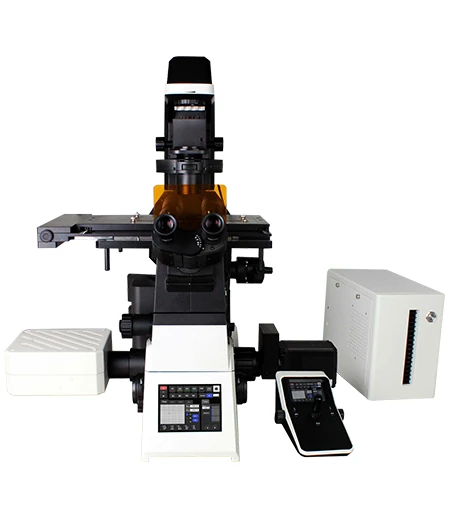
Connect microscope controls with image acquisition
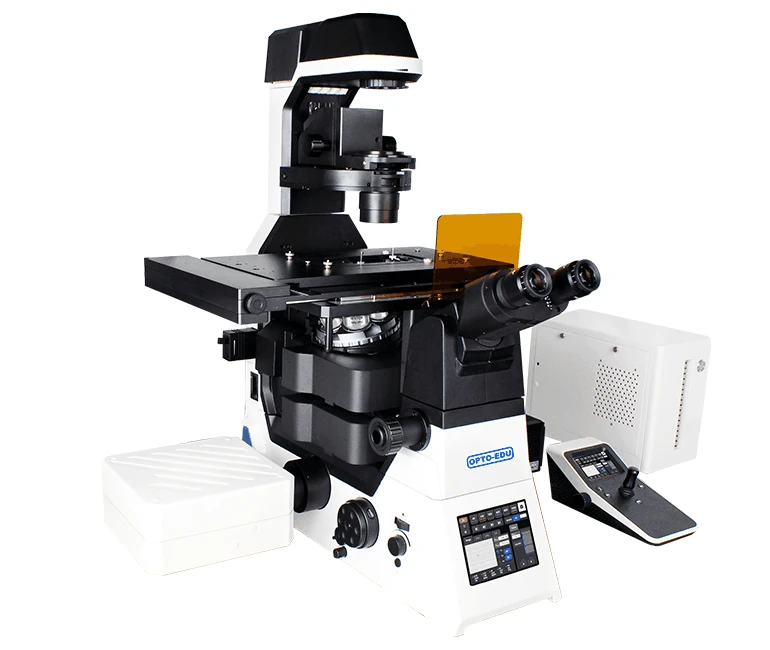
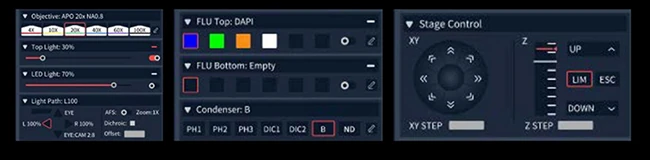
The feature list names motorized nosepiece, XYZ movement, condenser, and fluorescence turret control. The description also discusses stage manipulation and switching objectives, filter blocks, and observation modules. Ask which controls are available through the software and which remain at the instrument.
The acquisition section describes multichannel fluorescence imaging, time-lapse scanning, multiposition acquisition, Z stacking, and panoramic stitching. These functions are useful fields for a specification request: state which ones your experiment needs and whether they must be combined in a single sequence.
NomisProX-C is the software name used in the model description. Request its current version, included functions, file outputs, and license terms. If images must move into another analysis environment, identify that requirement before deciding how the acquisition workstation should be configured.
Published configuration information
| Item | Published information |
|---|---|
| Laser sources | Four listed |
| PMT detectors | Four listed |
| Pinhole | Motorized, stepless adjustment |
| Scanning coordinates | X, Y, Z, wavelength, time combinations |
| Motorized components | Nosepiece, XYZ movement, condenser, fluorescence turret |
| Listed operator interface | 5.7-inch touch screen |
| Named software | NomisProX-C |
Request the specific laser wavelengths, detector bands, objectives, and workstation details for the quoted configuration.
Describe the specimen and the output
Start with the specimen and its container. Give the sample dimensions, vessel type, required observation depth, and signals to record. Ask which objectives and stage arrangement are proposed, and include any working-distance or immersion requirement.
Next, describe the image sequence. A single field, a Z stack, a time series, and a multiposition experiment put different demands on acquisition planning. Specify the area, interval, and channels required as questions for configuration review. Ask for the storage and export arrangement that matches the resulting records.
For procurement, keep the microscope body, scan module, lasers, detection channels, objectives, computer, and software on the same itemized list. Request any evaluation documents needed by your laboratory and provide quantity and destination for the commercial offer.
Review the model in context
Compare the A64.1020 NIR-designated model within the confocal microscope category. Check the model-specific laser and detection tables rather than assuming the two listings have identical channels.
A64.1010 questions
Does four laser sources identify the supplied wavelengths?
No wavelength list is given in the feature summary used here. Ask for the actual supplied laser lines and detection-channel bands, then match them to the signals your experiment needs to record.
What software name appears in the source?
The model description names NomisProX-C. Request the current software version, supported acquisition functions, image exports, and license details for the system being offered.
Which acquisition functions are described?
The source describes multichannel imaging, time-lapse scanning, multiple positions, Z stacks, and panoramic stitching. Define the required sequence and ask how the selected optics, stage, software, and workstation support it.
Discuss the A64.1010 configuration
Send the model number and the specification requirements for your project. Ask OPTOEDU for an itemized configuration.
Reference: published A64.1010 product description.