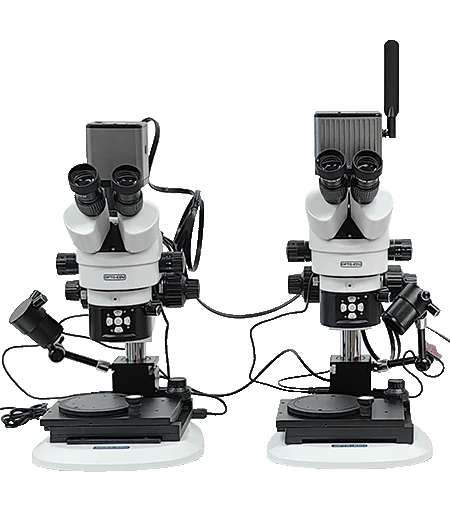
Define the paired-specimen task
Write down what will sit on each stage. Describe the objects' dimensions, shape, surface and mounting restrictions. Include the part you need to see, rather than only naming an industry. If an object cannot be clamped, rotated or placed flat, say so before asking for a holder.
Imagine comparing a small recessed feature with a reference object. Your request could identify the recess, the access available around it and the views you want to save. It should not assume that a photograph of the microscope proves the proposed holder can reach that feature.
Name the people who will review the result and the record they require. You might need live side-by-side viewing, saved still images or an annotated comparison. Present these as requirements to confirm. Do not treat the purchase of an instrument as evidence that a particular examination method or conclusion has been validated.
Separate essential requirements from items you would like to discuss. Give each one a short identifier so a supplier can answer it directly. If you are still deciding between viewing arrangements, say that in the request and ask for the proposed alternatives to remain clearly separated.
Specify optics and viewing arrangements
Ask the supplier to identify both optical paths, the proposed objectives and eyepieces, and how the magnification settings on the two sides are matched. Request the working distance and field of view for the configuration you plan to use. Keep these fields separate from the largest magnification printed in a heading.
List the viewing modes you need to demonstrate. Technical descriptions of comparison instruments distinguish optical contrast from split, superimposed or combined views; the Leica FS4000 description provides one independent example. Those features belong to that instrument and do not establish the configuration of an OPTOEDU model.
For your quotation, ask which views are optical, which are produced by software, and which are available in the saved image. If a measurement scale is required, request the calibration procedure and the applicable configuration. Agree on the evidence you need before selecting an acceptance tolerance.
Ask for a record of the setup behind any example image supplied with an offer. Identify the model, objectives, lighting and image-processing steps to the extent relevant to your task. You can then discuss what the example shows without assuming it represents a configuration that has not yet been quoted.
Record illumination as separate items
Avoid a single line that says “complete lighting.” List each requested source or attachment, how it is adjusted and whether the quotation includes it. Ask how the left and right illumination settings are controlled and recorded during a demonstration.
The published A18.1828 model information describes several lighting components. The A18.4903 listing separately describes near-coaxial, four-zone and six-color illumination arrangements. These are model-specific descriptions, not a reason to assume that the two packages contain interchangeable components.
| RFQ field | What to put in your request |
|---|---|
| Observation task | Object, feature and reference to compare |
| Light arrangement | Each requested source and attachment |
| Adjustment | Direction, intensity and left/right control to confirm |
| Quotation status | Included, optional or not proposed |
| Demonstration record | Sample, settings and saved view to supply |
Use the table as a question sheet. Leave an unanswered item visible instead of filling it with an assumption from another product page.
Check stages, holders and access
Request a list of the stages and holders supplied with the quoted model. Ask for the specimen size and mass limits, the available travel and rotation, and the clearance around the proposed mounting arrangement. Have the supplier identify any values that depend on the chosen holder.
A holder name alone is not an acceptance test. If your objects have irregular edges or must remain in a protective mount, describe that constraint and ask to see the proposed arrangement. State whether repositioning the specimen during the task is acceptable.
For motorized movement, ask which axes are controlled, how the operator commands them, and whether positions can be recalled in the offered software. For manual movement, request a demonstration of the adjustments you need. Neither choice should be selected merely because its description sounds more advanced. Compare it with the sequence your operator must complete.
Keep camera and software in the quoted configuration
Separate the microscope body from the camera, adapter, display, computer and software. Ask for the exact supplied items and their connection requirements. If you intend to use an existing workstation, provide its relevant configuration and ask for compatibility confirmation rather than assuming an adapter resolves every issue.
Request example files from the proposed arrangement. Ask which image formats, comparison views and annotations are retained on export, and which require the original software to reopen. Include licensing, installation and update questions in the written request; this checklist does not establish the supplier's terms.
The original A18.4903 description names image overlap and historical-image comparison functions. Treat those statements as questions for a demonstration of the current quoted configuration. A feature shown in a screenshot does not identify every accessory, license or computer included in your offer.
Use a repeatable acceptance checklist
Propose a short demonstration sequence and ask the supplier to confirm it. Identify the specimens, holder, illumination, magnification setting and required output for each step. Request a record of the actual configuration used, including any accessories substituted during the demonstration.
Decide who will assess the results and what evidence that person needs. Where your work calls for calibrated measurement, define the method and acceptance criteria with the responsible technical team. Do not borrow a tolerance from a different instrument or an unrelated application.
Before comparing quotations, mark each requirement as confirmed, proposed, optional or unanswered. Keep that status beside the relevant model number. Then ask for an updated itemized offer that resolves the outstanding points. This gives your purchasing discussion a concrete scope without turning a catalog description into a promise of examination performance.
Keep changes traceable. If your specimen, required view or included-items list changes, issue a dated revision of the worksheet and ask for the response against that version. Retain the previous response for comparison, but make the current request easy to identify. The aim is a readable purchasing record, with technical decisions and open questions assigned to the appropriate people.
FAQ
Is the highest magnification enough to compare quotations?
No. Request the objectives, eyepieces, working distance, field of view and matching arrangement for the settings you need. Ask the supplier to demonstrate your task with that configuration. Keep the largest listed magnification as one field in the comparison, rather than the whole specification.
Can I assume that similar A18 model numbers share accessories?
Do not assume it. Review each model's published information and request a separate included-items list. Ask which holders, lighting components, camera adapters and software functions belong to the offer you are evaluating.
What should accompany an inquiry?
Send the model or equipment type, specimen description, viewing task, required image record, quantity and destination. Include any handling restrictions and the demonstration evidence you would like to discuss. Avoid sending sensitive specimens or confidential records without first agreeing on an appropriate process.
Next step
Shortlist a model from the directory and send OPTOEDU your configuration requirements. Ask for the microscope, illumination, holders and image-recording components as separate quoted items. Identify unresolved requirements explicitly.
Sources and further reading
- Customer product evidence: published A18.4903 description.
- Customer product evidence: published A18.1828 description.
- Independent technical background: Leica FS4000 comparison instrument description. Its specifications are not OPTOEDU specifications.